
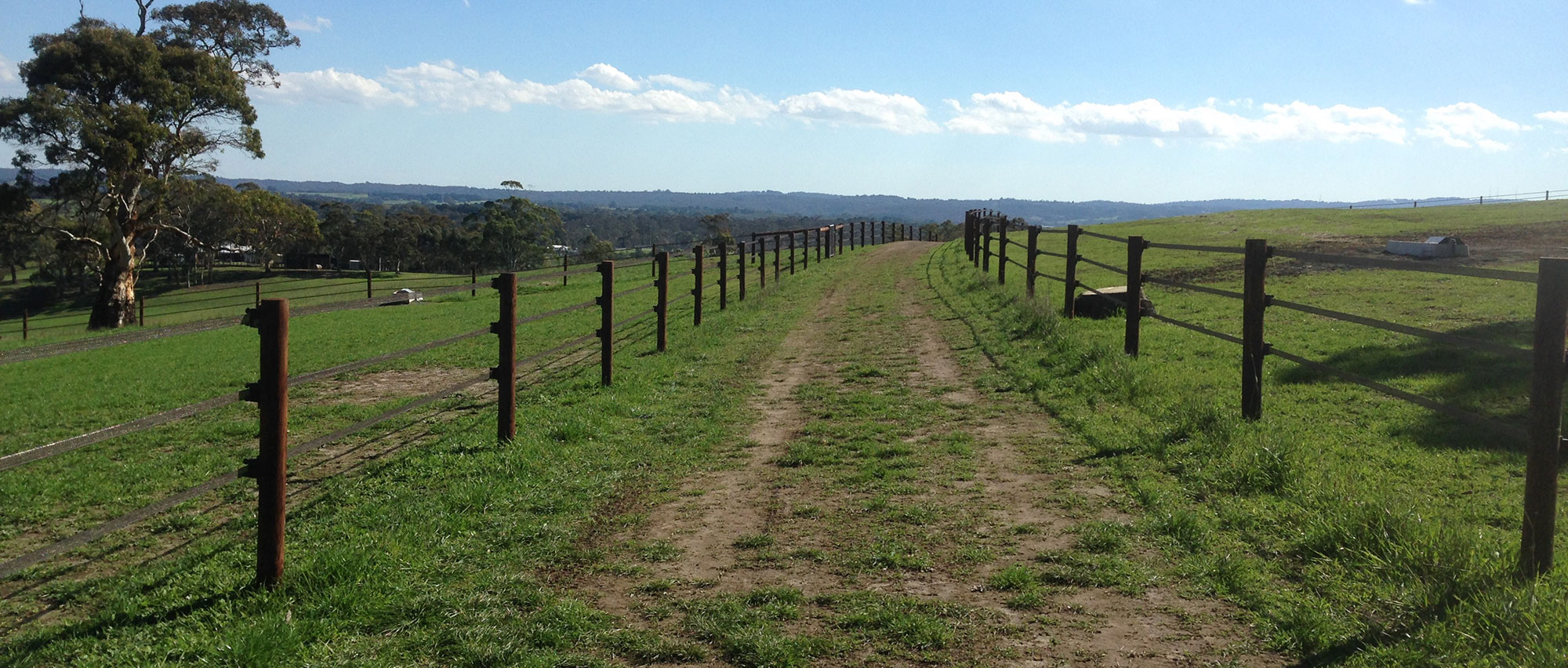
Hazardous fences
Squint your eyes and look at the picture below to get an idea of a horse's visual perception.
You will see only the two electric tapes, not the four strands of the barbed wire fence. Horses can't see small fencing material as well as they can see 40mm tape, making it more likely that a horse will sustain injury.
A common injury is cuts around the lower leg from pawing, but far more serious injuries also occur. Some will heal, some will cripple, and some will kill the horse.
This barbed wire fence has been made far safer by the addition of two strands of StockGuard 30mm tape, increasing visibility and thus keeping the horses away from the fence. Jagged barbed wire causes perhaps the worst injuries to horses, and as barbed wire is often rusty, infection is another hazard.
 These 10 strands of High Tensile have been converted to 9 wires + 1 tape.
Result :
same high tensile action + tape visibilty
Many people remove old fencing and simply use existing posts to attach 2 or 3 strands of StockGuard tape with the StockGuard insulator (F8) which adapts itself to a variety of fence post types.
There are fence situations where it would be more appropriate to provide a safe margin for the horse along the fence by installing the tape a small distance away from the existing fence.
 Wooden fences are popular with horses for chewing, cribbing, wind sucking, and other vices. Hours can be spent applying various concoctions to the wood to repel the horse, with limited and temporary success. Horses also like to rub up against solid fences. If a rail comes loose, a nail may stick out and cut the horse. If a rail breaks, it can be lethal to horses. Some have been killed by spearing themselves through their chests with a piece of wood rail. It's possible to protect such fences by running a strand of tape along the top rail. StockGuard tape can be used to keep the horses off the fence.
 Electric string is too small for a horse to see and is fairly easy for a horse to break. This endangers the horse when he is loose. This string has only three threads of wire. They do not connect with each other so the charge is unevenly spread along its length and tends to short easily. Because the current is carried this way, the string just doesn't give a sufficient shock to warn the horse.
  Electrified cord is dangerous because it is too resistant (2 tons breaking point), and too thin (1.2 cm wide). In Sweden, we know of more than six cases where horses have been permanently injured. The Dutch National Stud Farm installed it to enclose their stallions.
The result is in the photo.
 Pig netting or electric netting is a mesh with openings large enough for the horse to paw and get a hoof entangled, but not large enough for the horse to withdraw the trapped hoof easily. Many horses will lean over the low fencing trying to get to grass on the other side, paw, and become panicked when trapped.
 Solid fences offer a surface for a horse to rub against it. Depending on the fence this may not cause excessive problems. However it can constitute a potentially dangerous obstacle should the horse kick against it possibly resulting in broken leg bones.
 Vinyl fences look nice when new and are safe. However, horses do use it to rub against them. An adult horse can exert about 240 kilograms of lateral pressure and this can break plastic fencing. Ideally vinyl should be protected with one or two strands of electric tape.